ENGINEERING EVIDENCE · OCTOBER 10, 2026
Checked.
Then checked again.
Isolated fixtures and Android lab tests. No real email sends, purchases or changes to the physical phone.
This is a development validation report, not a security certification or uptime guarantee. Browser remote access and wearable integrations remain unvalidated. The candidate fixes are not yet published to the phone or restarted into production services.
Observed results
| Validation | Checks | Result |
|---|
| Baseline backend suite | 132 | Passed |
| Added HTTP security contracts | 6 | Passed |
| Full backend after hardening | 138 | Passed |
| Recorder lifecycle, interrupted save, pinned lab connection | 10 | Passed |
| Workout correction, durable outbox and terminal recording | 5 | Passed |
| Workout recovery after force-stop | 1 | Passed |
| Installed APK permissions and network boundaries | 3 | Passed |
| Activity order, supporting links and launch routes | 4 | Passed |
| Denied microphone and truthful error state | 1 | Passed |
| Forced recording process death and recovery | 2 | Passed |
Counts overlap across baseline and regression runs. The final full backend suite contains 138 tests. Emulator totals describe assertions within scenarios, not independent reliability samples.
What the iterations found
- Duplicate authentication headers could be accepted. Requests now require exactly one token header.
- Non-ASCII credential text could cause a request error. It now rejects with an unauthorized response.
- A denied microphone could show a misleading retained-audio message. The recorder now distinguishes “no audio created” from a recoverable capture.
The final affected backend and emulator checks passed after these fixes.
Routine use and failure cases
- Capture: start, pause, resume, save, discard confirmation, interruption and process-death recovery.
- Transfer: authentication, size/checksum bounds, retry deduplication and bounded network paths.
- Workouts: save and correct locally, survive process restart, synchronize receipts.
- Activities: chosen order, completion exclusion, supporting-document links and unsafe URL rejection.
- Decisions: exact revision, changed content/recipients, financial approval and ambiguous-send reconciliation.
- Operations: source-scoped traces, redaction, stale status and read-only dashboard boundaries.
Actual lab screens
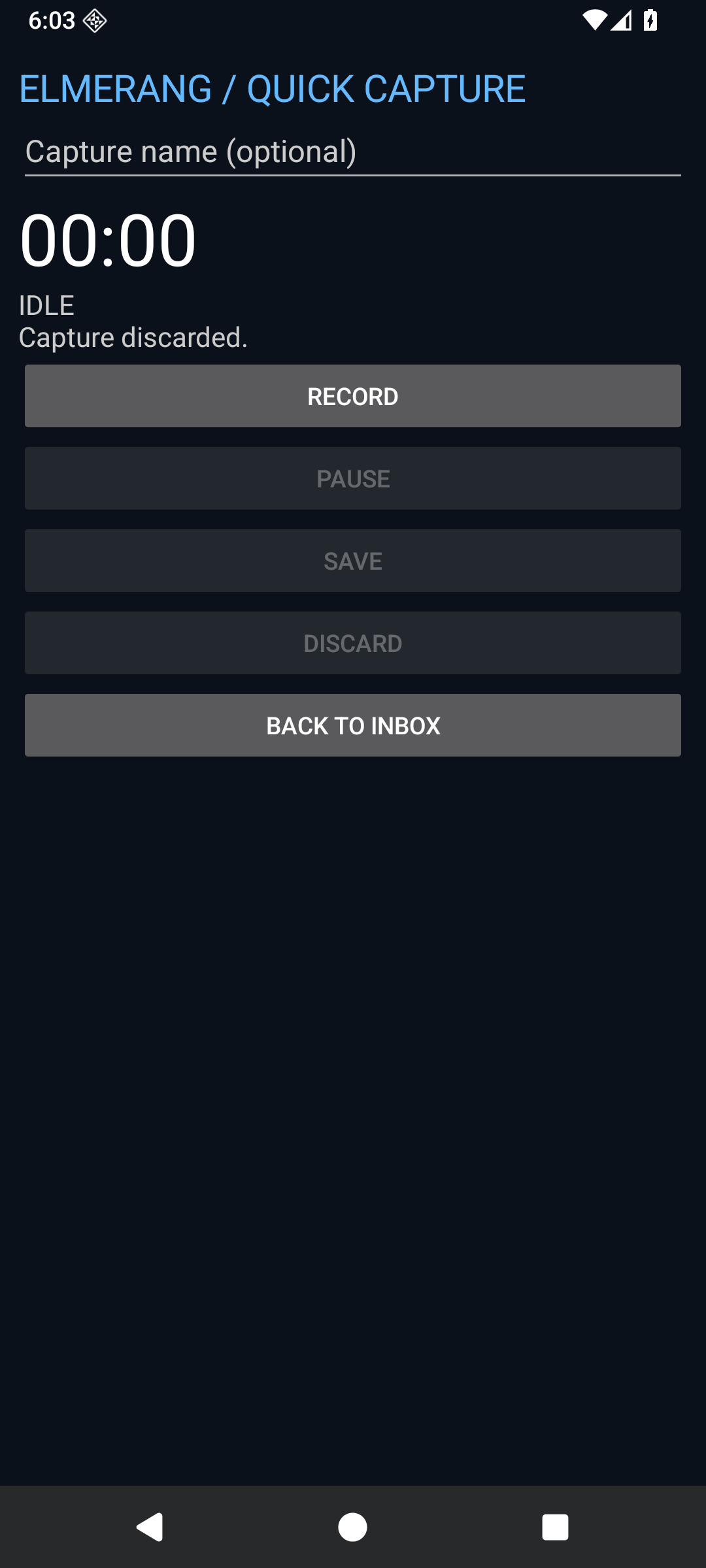 Recorder after a synthetic interrupted capture was recovered and discarded.
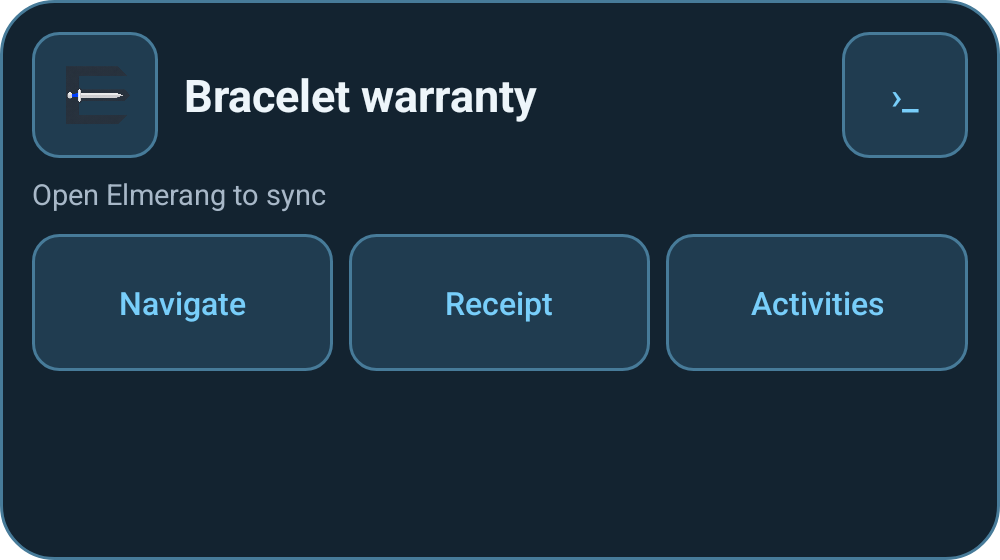 Native activity widget with synthetic receipt link.
Release gates still open
- Owner login, unauthorized-user denial, session expiry and tunnel-origin validation.
- Per-device enrollment, revocation and least-privilege credentials before additional installs. The current prototype uses a shared credential.
- Cellular access from outside the LAN, PC sleep/restart behavior and OEM battery restrictions.
- Earpiece/ring/watch pairing, locked-phone controls and notification behavior.
- Long-duration soak, disk-full and backup-restore drills; malicious or mismatched TLS peer testing.
- Local-model adapter evaluation. No provider-independence claim until the same fixtures pass on a local adapter.
Repeatable deployment
Run source audit and backend tests on every change. Build an isolated emulator candidate, then run the emulator release suite. Inspect synthetic screenshots. Publish an immutable release only after required gates pass; preserve the prior version for recovery. Run a physical smoke test and observe service health after deployment.
Runner: scripts/validate-release.ps1 -Emulator. Build and install the intended lab candidate first. CI runs the backend suite; emulator checks run locally.
Lab APK SHA-256: bff1a40b99c6663835d187711eaf5b10145bb9e707d4b18269d0f09ecca02193